

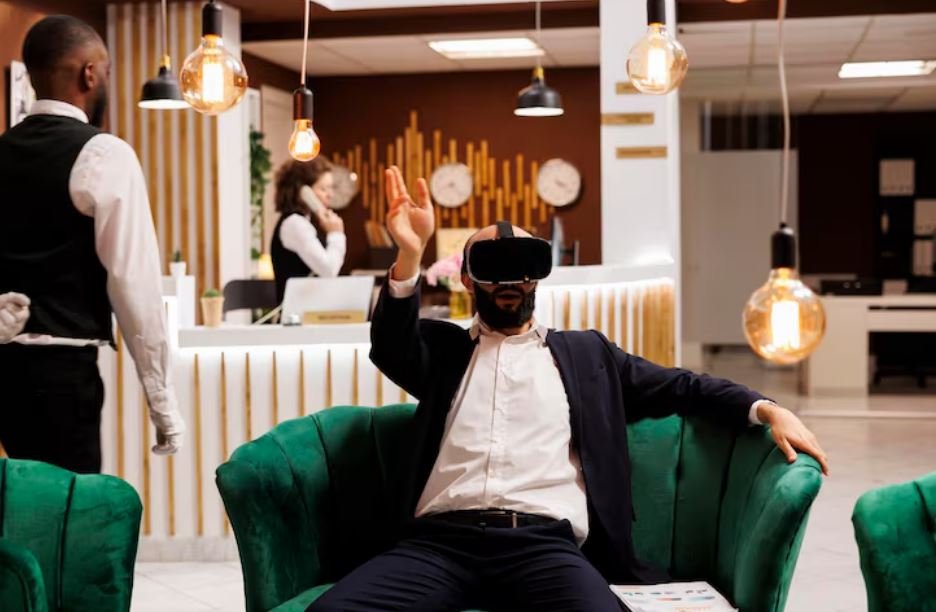
Guests no longer have to wait at the front desk or answer the in-room phone at the Beverly Wilshire, a Four Seasons Hotel in Los Angeles. Alternatively, they can call forth a hologram, which is a life-sized, three-dimensional concierge that appears directly within their suite. The experience combines comfort and technology in a way that feels remarkably natural, but it feels like something taken from a dream sequence in a movie.
The Proto M device, a small but effective device that can project a realistic hologram of a live concierge, has been installed by the hotel. The projection is a real-time interaction rather than a recording; every gesture and movement is flawlessly captured in light. Without ever leaving their suite, guests can make changes to their dinner reservations, ask for local recommendations, or even take advantage of a guided shopping experience on Rodeo Drive.
| Feature | Description |
|---|---|
| Location | The Beverly Wilshire, a Four Seasons Hotel in Los Angeles |
| Technology | Proto M hologram device projects real-time, three-dimensional holographic concierges |
| Function | Guests use the hologram to review itineraries, order services, or explore shopping options |
| Expansion | Aiden by Best Western hotels in Scandinavia employ Holobox systems for holographic check-ins |
| Prominent Backers | Proto investors include Paris Hilton, Howie Mandel, Lil Wayne, and Tim Draper |
| Industry Impact | Merging luxury service with holographic innovation to enhance personalization and efficiency |
| Reference | Beverly Wilshire Hotel – Four Seasons: Official Website |
It is “an evolution of service, not a replacement,” according to Serge Sturbois, Director of Guest Experience at the Beverly Wilshire. He makes a very clear point: luxury in the modern era is about convenience combined with personality. Visitors have the option of interacting with a person at the desk, texting that person, or having that same person show up as a hologram at the foot of their bed. The service is incredibly successful at fostering intimacy over distance, in addition to being futuristic.
David Nussbaum, CEO of Proto, saw this technology as a link between practicality and presence. When motivational speaker Chris Gardner made a holographic appearance at a business conference in 2021, his Los Angeles-based business initially attracted notice. Since then, art galleries, universities, and airports have all made use of prototype devices. However, putting them in hotel suites has significantly enhanced the way hospitality fosters relationships between employees and visitors by fusing emotional warmth with technological sophistication.
Despite being under three feet tall, each Proto M unit performs exceptionally well. A glowing depth produced by evenly spaced LED panels gives the impression that you are standing directly in front of someone. It feels engaging and personal to visitors. It provides hotels with an incredibly effective way to preserve service quality without being constrained by time or location.
Beyond California, the idea has spread widely. Using the Holoconnects Holobox system, Scandinavian hotels operating under the Aiden by Best Western brand have implemented holographic front desk employees across the Atlantic. A life-like hologram that greets visitors, describes the facilities, and walks them through self-check-in is activated by a motion sensor as soon as they enter the lobby. A remote employee can instantly beam into the box to help if a live interaction is required, even if they are located far away.
These Aiden hotels are run by CIC Hospitality, which claims that the strategy is especially helpful in resolving labor shortages while maintaining a very personalized visitor experience. Several hotels can be managed concurrently by a single customer service representative, cutting expenses without sacrificing quality. In terms of offering multilingual support and guaranteeing reliable service in various locations, the holographic hosts are especially creative.
This phenomenon has been rapidly amplified by social media. Videos of their check-ins are frequently shared by visitors, who describe them as “fascinating” and “slightly surreal.” But rather than being based on novelty, the fascination seems to be rooted in curiosity. The experience reimagines access rather than replacing people. Hotels are redefining how hospitality can feel both intimate and global by transforming employees into instantly accessible holograms.
The holographic concierge at the Beverly Wilshire has swiftly come to represent contemporary luxury. Concierges made of light, with the same charm but a hint of futuristic wonder, now occupy the same building that once housed Julia Roberts during Pretty Woman. Reed Kandalaft, the hotel’s regional vice president, emphasizes that visitors stay because the establishment consistently implements cutting-edge innovations. It’s a purposeful, elegant pursuit of advancement.
The technology of Proto is not limited to the hospitality industry. It has been utilized at events hosted by companies such as Amazon and Verizon, at New York’s Rockefeller Center, and even by comedian Howie Mandel, who once surprised passengers by “beamed” himself into JFK Airport. The company’s list of investors, which includes venture capitalist Tim Draper, Lil Wayne, Paris Hilton, and Marshawn Lynch, reads like a cross between Silicon Valley and celebrity culture. Their participation highlights the striking similarities between luxury, technology, and entertainment in their need to combine accessibility and presence.
There are significant travel-related ramifications. Hotels can connect guests to employees anywhere, even in another country or on a different property, by using holographic concierges. These systems may eventually be able to translate speech in real time or predict visitor needs by analyzing facial expressions and tone of voice by incorporating artificial intelligence. Cross-property coordination has a very wide range of possibilities, especially in international hotel chains.
Holographic technology has potential for the environment as well. Hotels can drastically cut emissions without sacrificing personal service by eliminating the need for on-site employees and transportation between locations. It’s a silent revolution in which a hologram’s light represents long-term advancement in upscale hospitality.
The holographic concierge represents a new reality in a time of hyper-personalization: the future of service is about fusing efficiency and emotion. Visitors want attention that feels real but is provided by extremely effective systems. This balance is skillfully accomplished by the Proto hologram. It enables concierges to be everywhere at once without sacrificing humor, eye contact, or conversation.
One should not undervalue the emotional impact of technology. One visitor reportedly compared the experience to “FaceTiming the future” during a demonstration. The digital barrier was immediately broken when the hologram responded, smiled, and made a lighthearted joke about the weather. Even through data and light, that shared moment of laughter felt very human.
By implementing these systems, hotels are also reconsidering their designs. While some are placing hologram pods close to lounges to provide individualized greetings, others are incorporating them into their penthouse suites. A holographic concierge’s visual presence subtly alters how visitors view service, making it seem more immediate, interactive, and impromptu.
The impact of technology on the hospitality industry goes well beyond aesthetics. It represents a change in culture where innovation is used to improve human connection rather than to replace people. Seeing such a private service based on technology that was previously only found in science fiction movies is especially inventive.
In the end, the hotel where a holographic concierge greets you is about redefining engagement, not just about show. These glowing figures symbolize a new kind of presence that moves more quickly than footsteps but feels rooted in sincerity, from the penthouse of the Beverly Wilshire to a boutique lobby in Denmark. What was once a luxury of proximity has become the new norm for access thanks to the holographic concierge.
And as the hospitality sector develops further, these radiant hosts serve as silent evidence that advancement can be exquisitely individualized. Don’t be shocked if it calls you by name, smiles sincere, and reminds you—through light and pixels—that the best service has always been about connecting with others.
